

.svg)



BiblioCon '26 brought public library staff together online from September 23-25 around a theme that feels especially relevant right now: how do libraries turn fast-moving technology and new ideas into something genuinely useful for their communities?
Across three days, we heard from library leaders, practitioners, and the BiblioCommons team about AI, accessibility, discovery, digital reading, security, and the changing expectations patrons bring to their libraries. Some sessions looked back at what libraries have learned. Others offered an early look at what is coming next.
It was also a milestone year for us! BiblioCommons turned 20, which gave us a chance to reflect on how far the online library experience has come. But the more interesting conversation was about where libraries are taking it next.
The Keynote: 20 Years of Libraries Moving the Digital Experience Forward
Marty Tarle, General Manager of BiblioCommons, opened BiblioCon with a reminder of just how different the digital world looked when BiblioCommons began in 2006. The iPhone didn’t exist. Streaming had not reshaped how people found and consumed media. And the expectations patrons now bring to every online experience were only beginning to take shape.
That set up the question that has followed BiblioCommons for 20 years: how should the mission of the public library show up online? As Marty pointed out, the answer has never belonged to BiblioCommons alone. Libraries willing to try something new, challenge what was not working, and share what they learned have shaped that answer alongside us.
Erica Reynolds, our VP of Strategic Library Engagement, brought that history to life before joining three library leaders for a conversation. Erica was IT Manager at Johnson County Library when it became one of the first U.S. libraries to adopt BiblioCommons. During the keynote, she traced milestones from the first BiblioCore catalog with Oakville Public Library in 2008 to early work with Boston Public Library, Seattle Public Library, and New York Public Library that brought eContent availability, holds, and checkouts directly into the catalog. Features that once felt radical are now simply part of what patrons expect.

A timeline shared during the BiblioCon ’26 keynote highlights 20 years of BiblioCommons milestones, from the launch of BiblioCommons in 2006 to new initiatives in AI and digital reading in 2026.
Three Library Leaders on What Changed
Erica and Marty were joined by Vicky Varga of Edmonton Public Library, David Leonard of Boston Public Library, and Paula Brehm-Heeger of the Public Library of Cincinnati and Hamilton County. Their libraries joined the BiblioCommons community at different points, but a common thread ran through the conversation: the online library is not separate from the library experience. It is part of the infrastructure that makes collections, programs, services, and staff expertise accessible to the community.
Vicky reflected on Edmonton's early decision to separate its discovery layer from its ILS so the library could create the experience patrons needed. David spoke about the value of libraries solving shared problems together and the responsibility to approach AI with "our eyes wide open." Paula connected the digital experience to her library's physical facilities strategy, noting that access to the library should not depend on the size of the building a patron happens to visit.
What Comes Next: Ask the Library
Marty closed the keynote by introducing Ask the Library, the next step in our AI work. It builds on Phase 1 of the BiblioCommons AI Initiative, where four partner libraries helped us test how AI could support common library questions, catalog discovery, and comment summaries while protecting the values patrons expect from libraries.
Ask the Library is designed to understand what a patron is trying to accomplish, not simply what words they typed into a search box. A request for dinosaur books for an eight-year-old should lead to the collection. A search for book clubs should surface events. A request for a room for four people from 2 to 4 p.m. should help the patron get closer to booking one. The work is now continuing with an expanded group of partner libraries. Yasmary Mora, Director of Product Management, shared more details about Ask the Library in her product roadmap session.
The Product Roadmap: Building What Comes Next on a Foundation of Trust
This year's product roadmap looked at where the BiblioCommons platform is headed and the principles guiding that work. The direction centers on making the patron experience more proactive, personalized, and frictionless, while keeping trust, privacy, accessibility, and security as the foundation.
Rethinking the Search Box with Ask the Library
Patron behavior is already showing us why search needs to evolve. When we look at search trends across library catalogs, we see people searching for things like study rooms or how to renew a library card, even though traditional catalog search wasn’t built to answer those questions. Asking patrons to choose the right search type or know which library system holds the answer simply shifts the work onto them.
Ask the Library is being designed to close that gap. An AI model interprets intent and then points patrons toward a short list of real next steps from the library's catalog, events, website, and FAQs. As Yasmary Mora, Director of Product Development, put it: “This is not a chatbot. We interpret the intent by using an LLM, and then we hand them a short list of real next steps.” Just as important is what happens behind the scenes. Patron data stays out of the model, and partner libraries are helping us work through questions of accuracy, bias, and safety before a patron-facing experience moves forward.

An early look at Ask the Library, showing how AI could help patrons find their next read by understanding what they enjoyed about a book and guiding them toward more personalized recommendations.
A More Rigorous Approach to Accessibility
Accessibility has been part of BiblioCommons product development for years, including our work toward WCAG 2.1 AA and an independent evaluation from the National Network for Equitable Library Service (NNELS). Now, we're adding another layer of independent evaluation through a three-year partnership with Level Access. Their team will audit our products against WCAG 2.2 AA, combining automated testing with hands-on evaluation by accessibility experts, including people with disabilities. Bringing those perspectives into the testing process helps uncover issues that automated scans alone can miss. A scan might flag missing alt text, for example, but it can't tell you whether the description is actually useful to someone using a screen reader. The work with Level Access will result in updated VPATs and a public remediation roadmap each year, giving libraries greater visibility into where our products stand and where we're continuing to improve.
Strengthening Security Behind the Scenes
Trust also depends on what happens behind the screen. Libraries hold personal information, and when public systems are disrupted, the impact is often greatest for people who rely on the library for access to technology and information. BiblioCommons encrypts patron data at rest and in transit, minimizes the data we collect, and continuously scans and independently penetration tests our applications. The next step is SOC 2, an independent audit of our security controls by a CPA firm on a regular schedule. The goal is not simply to say the platform is secure, but to give libraries evidence they can verify.
Bringing Digital Reading Back into the Library Experience
Among the new initiatives shared in this year’s roadmap was BiblioRead, a reading and listening experience designed to keep patrons connected to their library after they borrow a digital title. Today, borrowing an eBook or eAudiobook often sends patrons into a separate vendor app that has a non-library-branded interface, another login, and recommendations controlled by someone other than the library. BiblioRead is being built to let patrons read and listen inside their library's own app, with the library's brand and experience carrying through from discovery to borrowing to reading. It is vendor-agnostic and includes bookmarks, syncing across devices, and offline access. Founding partner libraries are helping shape the experience now, with a preview planned by the end of 2026 and general availability targeted for early 2027. BiblioRead represents an important step toward a more connected digital library experience.
Also on the Way
- Push notifications in BiblioApps for holds, due dates, renewals, and card expiration.
- Comment summaries that use AI to help readers quickly understand what the community has said about a title.
- Community-based recommendations, our first personalization feature, using anonymized activity to suggest what to explore next.
- Browse and Discover in BiblioApps, extending more library-curated discovery into the mobile experience.
- New BiblioEvents tools for staff, including layered roles and permissions, attendance reporting by audience, unlisted events, and library-created registration forms.
The Sessions that Drew the Biggest Crowds: Three Approaches To AI
The three most-attended sessions at BiblioCon all focused on AI, each exploring it from a different angle. Chicago Public Library shared how it is building AI understanding among staff. Toronto Public Library showed what community AI literacy can look like at scale. And Columbus Metropolitan Library explored the role of ethics, governance, and careful evaluation. Together, they showed ways libraries can play a meaningful role in helping their staff and communities navigate AI.
Chicago Public Library and AI: Lessons from the First Year
Nicole Steeves, IT Director at Chicago Public Library (CPL), shared how they moved from early questions about AI to an organization-wide approach grounded in staff learning. Its AI Ambassadors program brought together employees across roles and locations to develop AI Fundamentals training for roughly 1,000 staff, keeping library values at the center rather than pressuring staff to become AI advocates or experts.
The session also explored where CPL sees potential, particularly translation and accessibility, and how its work is beginning to extend from internal learning to public programs. For libraries wondering how to build staff confidence without minimizing legitimate concerns about AI, the session recording offers a practical look at what CPL tried, what it learned, and where it is still experimenting. If you don’t have access to the conference portal, you can request access to the recordings.

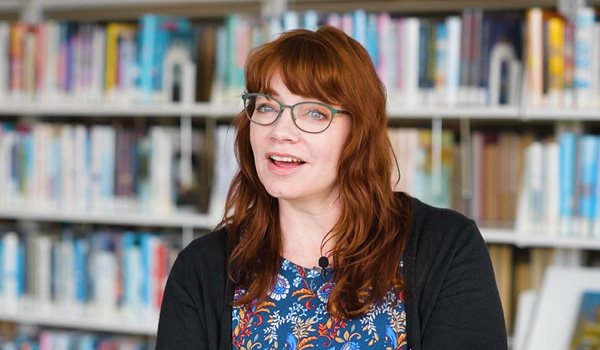
Cori Nicholls shares a behind-the-scenes look at moderating BiblioCon’s Library Technology track from her home office. (Photo shared by Cori on LinkedIn.)
Advancing AI Literacy at Toronto Public Library
Ab. Velasco, Manager of Innovation (AI Services), and Claire Fyfe, AI Librarian, shared how Toronto Public Library (TPL) is approaching AI literacy at city scale during their BiblioCon session. Their two-year initiative is designed to help more than 14,000 people from equity-deserving groups build practical AI skills, with a particular focus on employment.
Rather than relying on one program, TPL has created multiple ways for people to participate, including scholarships and learning circles, Innovator in Residence programs, public events and dialogues, providing AI tools in branches, and borrowable learning kits. Their advice to other libraries was equally practical: anchor the work in policy, build on existing digital literacy programs, and use the facilitation and information-literacy strengths library staff already have.
AI, Ethics & Opportunity: Lessons from Columbus Metropolitan Library's AI Journey
Justin Bumbico, Information Technology Officer, and Michaela Herrick, IT Systems Analyst, shared how the AI task force at Columbus Metropolitan Library (CML) evolved from staff feedback into building an ethical framework tied directly to the library's strategic values. The approach they shared during the conference session centers people throughout the process, with AI positioned to augment staff and patron skills rather than replace them.
One lesson that stood out was telling staff what the library chose not to do. After three years of reviewing products, testing guardrails, and examining privacy and risk, CML openly communicated about what they decided to adopt and what was set aside for the time being. They also shared their AI Ambassadors Academy, which will build AI fluency among staff and turn that learning into public programs at its locations.
What Comes Next for Public Libraries
If BiblioCon '26 made one thing clear, it is that libraries are not waiting for change to settle before deciding what comes next. They are testing, questioning, setting boundaries, learning from one another, and making deliberate choices about where technology can genuinely improve the experience for patrons and staff.
These conversations were at the heart of BiblioCon '26, and they don't have to end with the conference. Revisit a session you attended or catch up on one you missed by accessing the conference portal if you registered for the live event, or by signing up to watch the recordings.
And if what you hear has you thinking differently about what’s possible for your library, we’d be glad to keep the conversation going.
Frequently Asked Questions
What is BiblioCon?
BiblioCon is BiblioCommons’ annual conference for public library professionals. It brings together library leaders, practitioners, and the BiblioCommons team to share ideas, practical experiences, product developments, and perspectives on the changing digital library experience.
What were the main themes at BiblioCon ’26?
BiblioCon ’26 focused on how libraries are turning new technology and ideas into meaningful outcomes for their communities. Major themes included artificial intelligence, accessibility, security, digital discovery, digital reading and listening, patron personalization, and the evolving expectations patrons bring to their libraries.
How are public libraries approaching AI?
Libraries are approaching AI in different but complementary ways. At BiblioCon ’26, Chicago Public Library shared its approach to building AI understanding among staff, Toronto Public Library explored community AI literacy at scale, and Columbus Metropolitan Library discussed ethics, governance, and careful evaluation. Across these approaches, library values, staff learning, privacy, and community needs remain central.
What is Ask the Library?
Ask the Library is a BiblioCommons AI initiative designed to better understand what a patron is trying to accomplish and connect them with relevant next steps from their library. Rather than limiting a search to the catalog, Ask the Library is being designed to draw from library resources such as the catalog, events, website content, and FAQs. It is currently being developed with a group of BiblioCommons Partner Libraries, who are helping shape the guardrails along the way, including grounding answers in library-owned content, clearly labeling AI, and protecting patron privacy.
What is BiblioRead?
BiblioRead is a new reading and listening experience in development from BiblioCommons. It is being designed to let patrons read eBooks and listen to eAudiobooks within their library’s own app, extending the library experience from discovery and borrowing into reading and listening. Partner Libraries are helping shape BiblioRead, with a preview planned by the end of 2026 and general availability targeted for early 2027.
Where can I watch BiblioCon ’26 session recordings?
People who registered for BiblioCon ’26 can revisit sessions through the conference portal. Those who did not register for the live event can sign up for access to the recordings.